One card, held with a steady hand.
A single Major Arcana card, pulled fresh each day by the world's most well-read tarot hand — an AI steeped in centuries of card lore — and read the same grounded way as Angelica's daily horoscopes. No melodrama, just something honest to sit with.
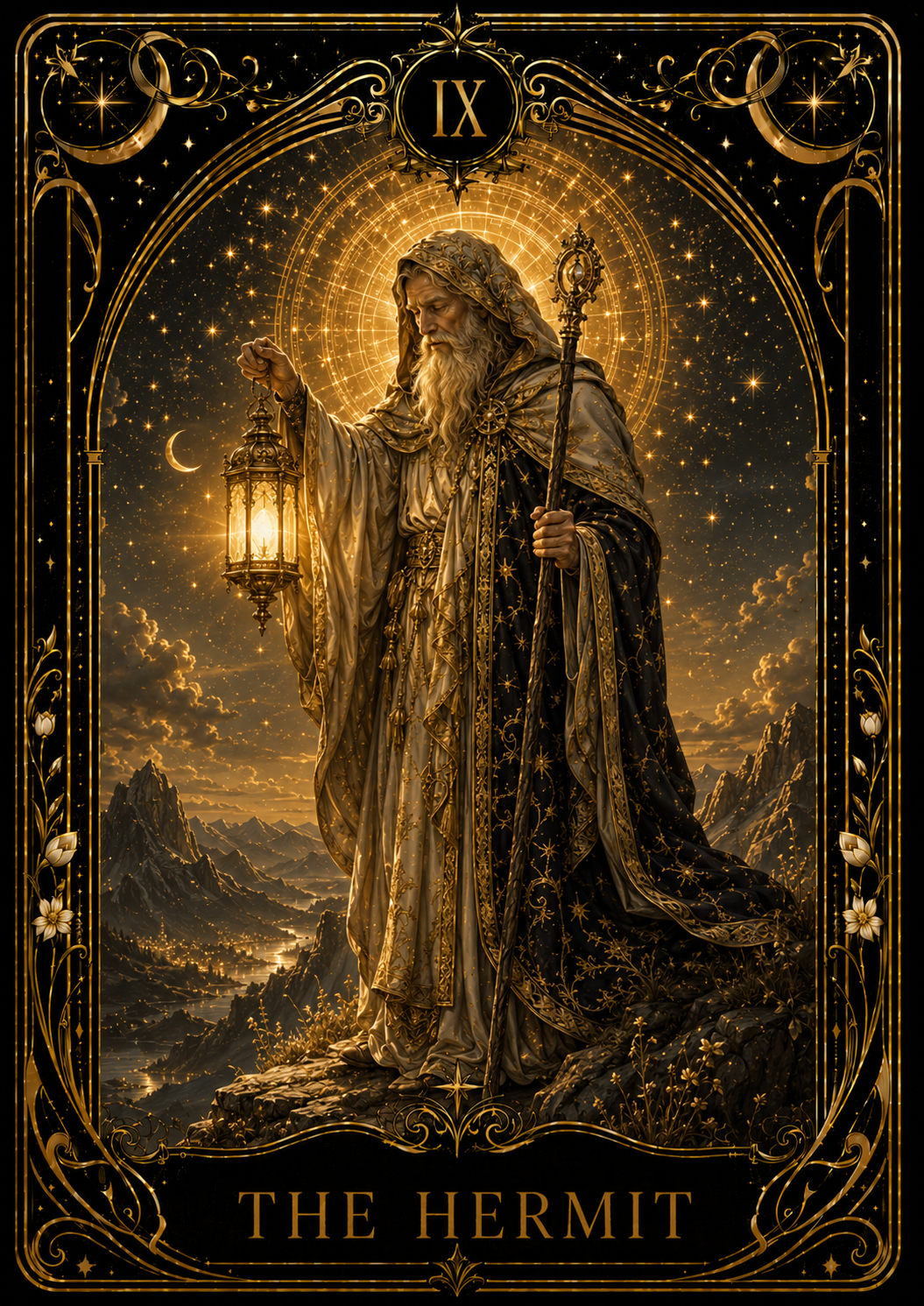
Today's card: The Hermit.
The Hermit appears reversed today, bringing solitude, reflection, inner guidance into view from a less direct angle. The invitation is to notice what feels blocked, internalised, delayed, or ready to be reconsidered.
What it means today
Reversed, it can mean isolation that has tipped into avoidance, or withdrawing from people who could actually help you think this through.
In its upright form, The Hermit is usually about solitude, reflection, and inner guidance. Reversed, those themes may be blocked, private, delayed, or asking for a less familiar expression. Notice which meaning fits the situation in front of you instead of forcing the card into a prediction.
Read the reversed meaning of The Hermit once, then write down the part that feels most relevant. Choose one small response that remains wise even if the card is only a reflective prompt.
You will get further today by stepping back from the noise than by joining more of it. The Hermit's light is a small, private one — enough to see the next step, not the whole road.
What question have you been answering for everyone except yourself?
Tarot in plain language, with one clear reflection for the day.
Each card is interpreted with warmth, clarity, and emotional honesty. Instead of throwing a dozen meanings at you, Angelica gives you one grounded theme to sit with and one question worth carrying into the rest of the day.
The 22 cards that carry the deepest weight.
The deck Angelica reads from is the Major Arcana — the twenty-two named cards that form tarot's spine. Each one represents an archetypal situation or inner turning point that recurs across human life, from the sudden leap of The Fool to the culmination of The World. Modern readers often describe the sequence as the Fool's Journey: a reflective map through innocence, trial, loss, revelation, and completion.
You do not need to memorise the sequence to benefit from a daily pull. But knowing that these cards carry the major themes — love and its loss, power and its misuse, beginnings and the endings that make room for them — helps you meet today's card as something deeper than a fortune-cookie line. The card is an invitation to reflect, not a verdict delivered from above.
The Fool, The Magician, The High Priestess, The Empress, The Emperor, The Hierophant. These speak of beginnings, raw potential, intuition and structure — the forces that set something in motion.
The Lovers through Wheel of Fortune, then Justice through The Devil. These track choice, reversal, justice, surrender and the shadow-work that real growth demands.
The Tower, The Star, The Moon, The Sun, Judgement, The World. Collapse and renewal, hope after devastation, illumination, and the sense of arriving somewhere earned.
One card is a mirror, not a prediction.
A daily tarot pull gives you a single focal point for reflection — one theme, one question, one angle on the day ahead. The card Angelica draws is the same one every visitor sees, because the point is a shared meditation rather than a private forecast. Think of it the way you might think of a daily horoscope: a lens to look through, not a set of instructions to obey.
What a pull cannot do: tell you with certainty what will happen, guarantee an outcome, reveal another person's private thoughts, or substitute for your own judgement. A card that suggests patience does not mean wait. A card that suggests release does not mean quit. Angelica's editorial standard treats the cards as a conversation, not a command.
What a pull genuinely can do: slow you down enough to notice a pattern you were moving too fast to see, give language to a feeling that was sitting below the surface, or offer a useful reframe when the day feels tangled. That is modest, and it is real. The card works when you work with it.
Orientation changes the conversation.
Every card in the Major Arcana carries a core meaning. When the card appears upright, that meaning tends to flow outward openly and constructively. When the same card appears reversed — upside down — the meaning is often internalised, blocked, inverted, or asking to be looked at from underneath. A reversed card is not a punishment or a bad omen. It is the same archetype knocking from a different door.
For example, The Tower upright can signal a sudden, necessary clearing — something false collapsing so something truer can be built. Reversed, it may point to a collapse you are resisting, or one that is unfolding slowly rather than all at once. The Sun upright radiates joy and clarity; reversed, it may ask where the light is being blocked or where a cloud will pass. Angelica reads the orientation as texture, not as a binary of good and bad.
Some traditions do not read reversals at all, treating every card as containing its full spectrum of meaning regardless of orientation. Both approaches are legitimate. What matters is consistency and honesty: read the card in front of you rather than the card you wish you had drawn.
What readers actually want to know.
Is the daily card drawn randomly?
No. Angelica's daily card is determined by a fixed process tied to the date, so every visitor who opens the page on the same day sees the same card. This mirrors how the daily horoscope works: one shared reading for the collective, not a private draw per person. The intention is a common reflection point, not a personalised spread.
Can I draw my own card instead?
Absolutely, and Angelica encourages it. The daily pull here is a starting point. If you have your own deck — or even a tarot app — drawing a card yourself and holding it alongside today's collective card can deepen the reflection. The two readings do not compete; they complement each other. Your personal draw speaks to your immediate question, while the collective card speaks to the wider atmosphere of the day.
What if the card feels wrong or upsetting?
A card like The Tower, Death, or The Devil can land hard, especially on a difficult day. Angelica does not treat these cards as literal forecasts of disaster. Death often signals transformation and the end of a chapter. The Tower can signal an unstable structure breaking open. The Devil can point to attachment or bondage — often to a pattern rather than a person. If a card unsettles you, sit with what it is pointing at rather than treating it as a forecast of harm. No card replaces your own discernment about a real situation.
Do I need to know tarot to get something from this?
Not at all. Angelica writes each reading in plain language with a clear theme and a reflection prompt, so you can use the daily card as a moment of pause whether or not you have ever held a deck. If you want to go deeper, the Major Arcana section above gives you the landscape, and the tarot beginner's guide in the Insights library walks through the full set of cards in more detail.
How often should I read the daily card?
There is no rule. Some people check every morning as part of a reflective routine. Others drop in when a day feels muddled and they want a different angle. The card is here every day regardless. What makes it useful is not frequency but attention — a single honest minute with the card will do more than a rushed skim followed by forgetting it.
Is tarot connected to a specific religion?
Tarot as a deck of cards originated in fifteenth-century Italy as a game, and the esoteric reading tradition developed over subsequent centuries through a blend of Hermetic, Kabbalistic, astrological and Christian mystical influences. No single religion owns it. Practitioners today come from many traditions and none. Angelica treats the cards as a universal symbolic language rather than the property of any one faith.
Carry today’s card into the next reading.
Save your sign on the homepage and these next steps will adapt automatically on this device.
Return to your sign.
Take today’s card back into the live horoscope flow and keep the same emotional thread moving.
Read horoscope →Try the sign pairing next.
Choose two signs and see where chemistry, rhythm, and friction actually sit.
Check compatibility →Browse the insights library
Move from the card into a longer essay with more context and emotional texture.
Read the next insight →